For many business owners, tax becomes a priority when a deadline approaches. By then, several decisions affecting the tax position may already be locked in. Pricing, investment, financing, distributions, staffing and changes to the business structure can all alter the obligations created during the year. Business tax management means understanding those consequences while decisions can still be assessed, rather than simply reporting them afterwards.
Strong business advisory brings tax into commercial planning, giving owners a clearer view of what their decisions may create. The result is a tax process built around the business, rather than a return prepared after the year has finished.
Tax Is a Business Cost You Need to Understand
The useful tax question is not simply, “How do I pay less tax?”
It is, “What tax obligations is my business creating, and when will they require cash?”
That distinction changes how owners look at financial performance.
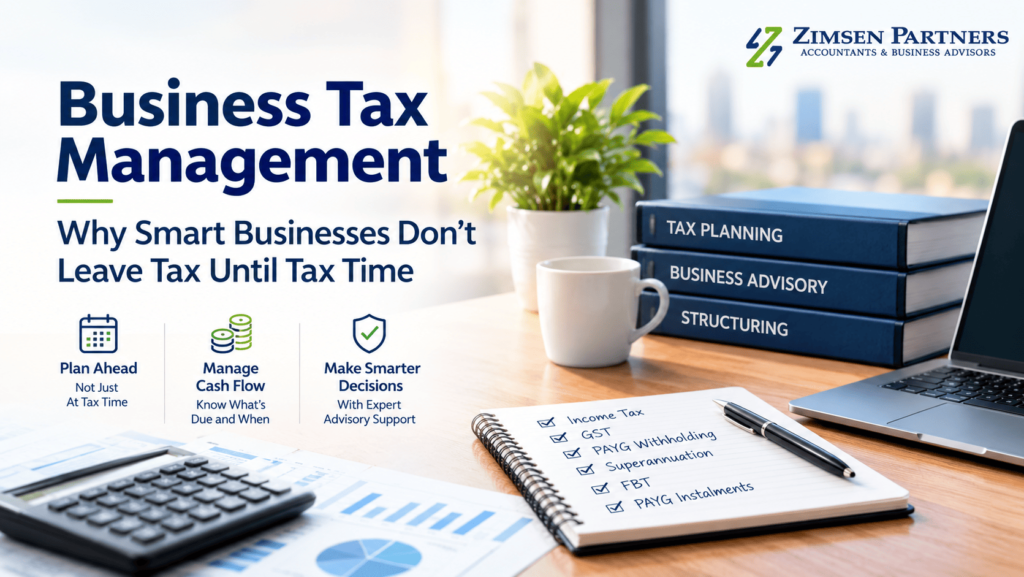
A business may have several tax obligations operating at the same time:
- Income tax on taxable business income
- GST collected and paid through taxable transactions
- PAYG withholding from employee payments
- PAYG instalments towards the business’s income tax liability
- Superannuation obligations for eligible employees
- FBT where employee benefits create a fringe benefits tax liability
These obligations arise from different activities and can fall due on different schedules. A profitable period can therefore create several future payments without those amounts appearing as a single expense in the bank account.
For 2026–27, the ATO has also applied a 5% GDP adjustment factor to quarterly GST and PAYG instalments for businesses using the relevant instalment methods. That makes the relationship between current trading performance and future tax payments worth monitoring rather than assuming an earlier instalment amount will remain appropriate.
Good business tax management starts with knowing what each obligation represents, what triggers it and when cash will be required.
Tax and Cash Flow Are Connected
Revenue entering the bank account can create a misleading picture of financial capacity.
Consider a business that receives $110,000 from customers, including $10,000 of GST. The bank balance has increased by $110,000, but the business does not have $110,000 of unrestricted operating cash. Part of that receipt relates to GST, while other amounts may need to cover wages, superannuation, suppliers, PAYG and future income tax.
The same issue can arise when a business collects customer payments well before its tax liabilities fall due. The cash can look available simply because the related obligation has not reached its payment date.
A useful management model keeps three figures separate:
Revenue shows what the business has generated from its activities.
Profit reflects income after recognised expenses and relevant accounting adjustments.
Available cash reflects what can be spent after considering existing and expected obligations.
Those figures can move in different directions.
A business with strong sales can therefore experience tax-related cash pressure even while its profit remains positive. Cash forecasting needs to account for the timing of tax payments rather than relying on the bank balance as the measure of funds available for spending.
Don't Make Tax Decisions After the Transaction
Tax advice becomes harder to use once the commercial decision has already been completed.
Buying or selling an asset, acquiring another business, changing the ownership structure, restructuring an entity or distributing profits can create tax consequences that depend on the terms, timing and legal form of the transaction.
The same applies to new arrangements involving related entities, shareholders or trusts. The tax treatment may depend on facts that are determined when agreements are negotiated.
For example, an asset acquisition may require consideration of depreciation treatment, ownership, GST and the timing of the expenditure. A restructure may raise questions around capital gains tax, GST, entity ownership and the transfer of existing assets.
The critical point is timing.
The best time to ask “What are the tax implications?” is before you sign, not after.
Zimsen Partners’ published services include transaction and event-based tax advice, covering decisions such as asset acquisitions, changes and restructures. Bringing tax advice into the transaction stage gives the business an opportunity to assess the consequences before the documents become binding.
Know What Each Tax Obligation Relates To
A business tax system becomes easier to manage when each obligation has a clear purpose.
| Obligation | What It Relates To |
| GST | GST collected and paid through business transactions |
| BAS | Reporting GST and certain other obligations |
| PAYG withholding | Tax withheld from employee payments |
| Income tax | Tax on taxable business income |
| Super | Employer superannuation obligations |
| FBT | Certain benefits provided to employees |
The distinction matters because these obligations do not all represent the same type of liability.
GST generally relates to transactions with customers and suppliers. PAYG withholding arises through payroll. Income tax relates to the taxable result of the business. Superannuation follows employment obligations, while FBT can arise from particular benefits provided to employees.
A BAS can also bring several obligations together. The ATO states that businesses registered for GST use the BAS to report and pay GST and, where applicable, PAYG instalments and PAYG withholding. Even a nil BAS generally still needs to be lodged by the due date.
This is why an annual income tax return cannot represent the entire tax position of an operating business.
Poor Tax Management Can Create Financial Pressure
Tax problems do not always begin with an incorrect return.
They can begin with a liability that was not included in the cash forecast, a payment that was missed, a payroll process that did not produce the required information, or an obligation that was identified after the money had already been spent elsewhere.
The financial consequences can then extend beyond the original liability.
The ATO General Interest Charge applies to certain overdue tax debts. For the quarter from 1 July to 30 September 2026, the GIC annual rate is 11.43%. The Shortfall Interest Charge for the same period is 7.43%.
GIC also compounds daily. From 1 July 2025, GIC and SIC incurred on relevant amounts are no longer tax deductible.
That makes timing a financial consideration. A business that identifies a projected shortfall early can review its cash requirements before the liability becomes overdue. A business that identifies it after the due date has fewer financial choices available.
Penalties and interest are therefore only part of the issue. The larger management problem can be the disruption caused when an unexpected tax liability competes with wages, suppliers, finance repayments or planned expenditure.
Review Tax Throughout the Year
Tax management needs a review cycle that follows the business rather than waiting for the annual return.
A useful review can cover five areas:
Financial position
Has profitability moved materially from the assumptions used for previous tax instalments or forecasts?
Tax position
Are GST, PAYG, income tax and other obligations tracking in line with current trading activity?
Cash flow
Will upcoming liabilities be funded without drawing cash away from essential operating commitments?
Structure
Have changes in ownership, revenue, assets or activities created a reason to reassess the existing business structure?
Major transactions
Are acquisitions, disposals, investments, restructures or other significant transactions approaching that require tax analysis before completion?
The frequency can depend on the business. A company making frequent acquisitions may need transaction reviews throughout the year. A smaller business with relatively stable activity may use monthly management accounts and quarterly tax reviews as its main checkpoints.
The important factor is that the review occurs while decisions can still be changed.
What a Proactive Tax Adviser Actually Does
A proactive tax adviser has a broader role than preparing returns and checking historical figures.
The work can include:
- explaining the current tax position in commercial terms
- forecasting upcoming tax liabilities
- identifying areas that need further investigation
- assessing tax consequences before significant transactions
- reviewing records supporting tax positions
- coordinating required lodgements
- responding to ATO correspondence
- assessing distributions through companies and trusts
- incorporating tax considerations into wider business planning
Zimsen Partners’ published tax services include income tax planning, transaction and event-based tax advice, business structuring, wealth protection, dividend and trust distribution analysis, year-end tax planning and PAYG estimations.
That combination matters because a transaction can affect several parts of the tax position at once. An adviser looking at only the annual return may see the final consequence. An adviser involved earlier can assess the transaction itself, the structure surrounding it and the expected effect on future obligations.
Tax Compliance and Tax Management Are Different
This is the distinction that sits at the centre of the entire tax conversation.
| Tax Compliance | Tax Management |
| Reports what happened | Plans for what is coming |
| Works around deadlines | Works around business decisions |
| Prepares required returns | Assesses tax consequences before transactions |
| Primarily looks backwards | Uses current information to plan ahead |
| Focuses on reporting obligations | Connects reporting with planning and commercial decisions |
Compliance remains necessary. A business still needs accurate records, correct calculations and timely lodgements.
Management adds another layer.
It asks what the figures mean for the decisions the business is making now and what obligations those decisions may create later.
Compliance tells you what you owe. Tax management helps you understand why and plan for what’s next.
That difference can affect the timing of an investment, the way a transaction is structured, the amount of cash reserved for liabilities and the questions raised before a major decision is approved.
Questions Every Business Should Be Asking About Tax
Rather than waiting for the accountant to identify every issue at year end, owners can use a short internal review throughout the year:
- Do we know which tax obligations apply to our current activities?
- Are upcoming tax liabilities included in our cash forecasts?
- Have changes in revenue, profitability or staffing altered our tax position?
- Have we made any significant purchases or disposals since the last review?
- Are any ownership, financing or structural changes being considered?
- Are shareholder, director and related-party transactions being recorded correctly?
- Are our BAS figures consistent with the underlying accounting records?
- Are payroll records supporting our withholding and super obligations?
- Have any new employee benefits created a potential FBT issue?
- Are we asking for tax advice before significant agreements are signed?
These questions provide a practical checkpoint between formal tax engagements.
They also help identify when a business needs advice rather than simply another lodgement.
Business Advisory, Business Tax Management and a Business Advisory Service
Tax decisions rarely sit inside a tax department of one.
A pricing decision affects revenue and GST. Hiring affects payroll withholding and super. Financing can affect interest deductions and cash flow. An acquisition can affect structure, GST and capital gains tax. A distribution can raise questions around company profits, shareholder taxation, trusts or Division 7A.
That is why business advisory can add value to tax planning. It connects the tax position with the commercial information needed to interpret it.
A business advisory service can also help owners distinguish between a tax issue and a broader financial issue. A projected tax bill may be correct but still create a funding problem. A change in profitability may make an existing PAYG instalment position less representative of current trading. A planned restructure may have commercial reasons that need to be assessed alongside its tax consequences.
Tax becomes part of the decision-making process rather than a separate compliance task.
Zimsen Partners for Year Round Tax Management
Tax management is not about finding ways around tax. It is about understanding the obligations a business creates, planning for them and assessing their consequences before important decisions are completed.
Zimsen Partners combines accounting, tax compliance, business advisory and business structuring services to support businesses throughout the year. Its tax offering covers planning, compliance, transaction and event-based advice, structuring, distributions, PAYG estimations and related business matters.
For an owner, that means the conversation can move beyond “What was our tax bill?” towards more useful questions about what created it, what is changing and what needs to be considered next.
Want to take a more proactive approach to your business tax? Speak to Zimsen Partners.

Frequently Asked Questions
Is business tax management only relevant to companies?
No. The scope depends on the business structure and activities. Sole traders, partnerships, trusts and companies can all have different combinations of income tax, GST, PAYG, superannuation and other obligations. The relevant structure determines which obligations need to be monitored.
How often should a business review its tax position?
There is no single review frequency that suits every business. Businesses with frequent transactions, rapid changes in profitability or significant payroll activity may need more frequent reviews. A quarterly review can provide a useful baseline for businesses with relatively stable operations.
Can tax management affect business pricing?
Yes. GST treatment can affect the amount charged to customers and the amount remitted to the ATO. For some businesses, tax considerations can therefore form part of pricing analysis alongside costs, margins and market conditions.
Does tax management include ATO communication?
It can. A tax adviser may assist with ATO correspondence, requests for information, payment arrangements, amendments and other matters arising from the administration of tax obligations.
What records should a business keep for tax management?
Records should support the transactions and calculations used to determine tax obligations. Depending on the business, this can include invoices, receipts, payroll records, asset registers, contracts, financing documents, transaction records and records supporting GST and other tax treatments.
Can a business change its tax structure during the year?
A business structure can sometimes be changed, but the consequences need to be assessed before implementation. Moving assets, changing ownership or transferring business activities can create tax and legal consequences that depend on the proposed arrangement.
Why do PAYG instalments need monitoring?
PAYG instalments are payments towards a future income tax liability. If business performance changes substantially, the instalment position may no longer reflect the current circumstances. Reviewing the position can identify whether the instalment calculation needs further consideration.
Does buying an asset always create an immediate tax deduction?
No. The tax treatment depends on the type of asset, its cost, how it is used, the taxpayer’s circumstances and any applicable depreciation rules or concessions. The timing and structure of the purchase can therefore matter.
Can distributing company profits create tax issues?
Yes. The treatment depends on how funds are distributed and the company’s circumstances. Dividends, loans and other payments can have different tax consequences, particularly where shareholders or associates receive amounts from a private company.
What should a business discuss with its accountant before a major transaction?
The business should provide the proposed transaction details, timing, parties involved, ownership arrangements, expected consideration and commercial purpose. This gives the adviser the information needed to assess relevant tax consequences before the transaction is completed.